

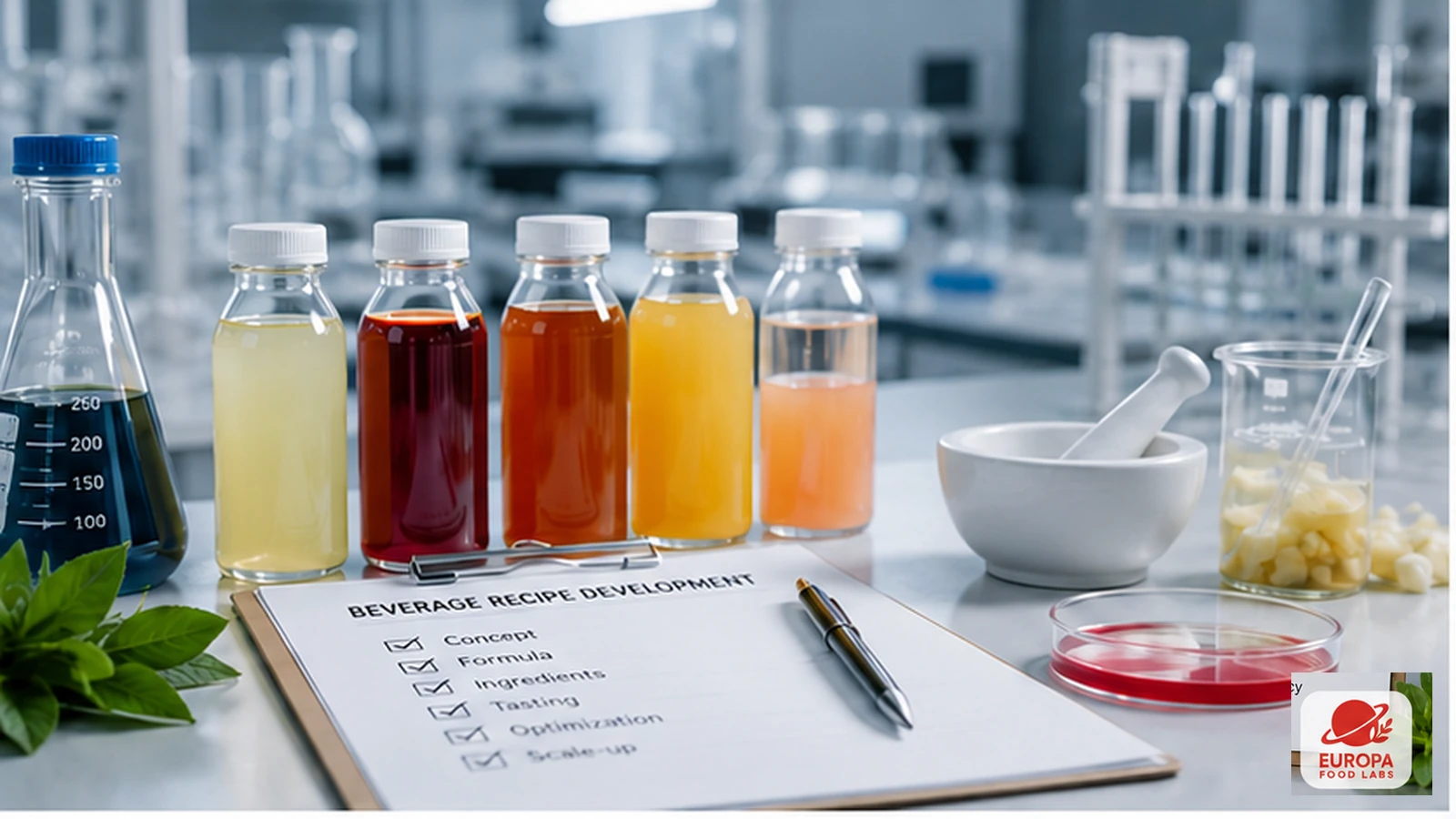
Developing a commercial beverage is not simply a matter of mixing flavours and ingredients until the sample tastes pleasant. A successful project must connect product positioning, formulation science, ingredient compatibility, processing conditions, packaging, regulatory requirements and the realities of industrial production.
1. Defining the project brief
Every serious beverage development project begins with a structured brief. The development team needs to understand the beverage category, target market, intended consumer, flavour direction, nutritional objectives, packaging format, expected annual volume, target shelf life and planned launch timetable.
A clear brief reduces unnecessary development rounds and helps ensure that technical decisions support the commercial objective from the beginning.
2. Company qualification, confidentiality and MNDA
Before confidential formulation details are exchanged, the parties should establish who is involved, whether the customer is an active registered business and whether the brand or trademark is protected or formally under application.
A mutual non-disclosure agreement provides the framework for discussing product concepts, technical information and commercial plans. Confidentiality should come before detailed formula discussions, not after them.
3. Product architecture and formulation strategy
Once the project scope is defined, the formulation is designed around the desired product experience and technical requirements. This may include water quality, juice content, acids, sweeteners, flavours, colours, extracts, vitamins, minerals, amino acids, preservatives, stabilisers and other functional ingredients.
The development team must consider how these components interact. A change to sweetness can alter acidity perception. Botanical extracts can affect colour, sediment and bitterness. Vitamins and minerals may influence taste and stability. Carbonation can change aroma release and mouthfeel.
4. Ingredient and flavour-system selection
Ingredients should be selected for more than their individual specifications. Their performance must be evaluated within the complete beverage system.
Flavour selection may involve natural flavours, natural-identical profiles where legally permitted, masking systems, flavour enhancers and top notes. Functional beverages often require additional work to manage bitterness, metallic notes, astringency or lingering aftertaste from active ingredients.
Supplier documentation, dosage guidance, allergen information, regulatory status and availability at commercial volumes are also important parts of the decision.
5. Laboratory prototypes and controlled adjustments
Laboratory samples allow the development team to test the proposed formulation under controlled conditions. Adjustments may be made to flavour intensity, sweetness, acidity, colour, mouthfeel, carbonation target and functional-ingredient balance.
Each round should have a clear objective. Random changes make it difficult to understand which adjustment improved or weakened the product. Controlled development creates a traceable path toward the selected formula.
6. Sensory evaluation and customer feedback
The customer evaluates the samples against the project brief, brand positioning and target consumer. Useful feedback is specific: for example, less sweetness, brighter citrus top notes, softer bitterness or a fuller mouthfeel.
Feedback such as “make it better” is too subjective to guide technical work efficiently. Structured sensory comments help the laboratory make precise adjustments and reduce the number of unnecessary sample rounds.
7. Stability and shelf-life considerations
A beverage that tastes excellent on the day it is prepared may not remain acceptable during storage. Development therefore needs to consider physical, chemical, sensory and microbiological risks.
Potential issues include sediment, separation, colour fading, flavour loss, vitamin degradation, gas loss, haze formation, interaction with packaging and microbial growth. The appropriate validation programme depends on the formulation, process, packaging and target shelf life.
Shelf-life expectations should be confirmed through suitable testing. A laboratory formula alone cannot guarantee long-term performance without validation under the intended production and storage conditions.
8. Process and packaging compatibility
The same formula may behave differently depending on mixing equipment, water treatment, heat treatment, carbonation, filling method and packaging format.
Aluminium cans, PET bottles and glass bottles each bring different technical and commercial considerations. The product may also be affected by hot filling, tunnel pasteurisation, flash pasteurisation, aseptic processing or cold filling with preservatives.
For this reason, the development route should consider the intended manufacturing process from the start rather than treating production as a separate final step.
9. Industrial scale-up and production trials
Moving from a laboratory sample to a commercial tank requires careful technical transfer. Ingredient order, mixing time, agitation, temperature, dissolution and carbonation conditions may all influence the final result.
The first industrial production should be treated as a controlled scale-up and validation exercise. The production team and development partner should confirm responsibilities, process parameters, quality checks and approval points before the run.
10. Final production readiness
A beverage is ready for commercial production only when the approved formulation, ingredient specifications, process conditions, packaging, quality criteria and responsibilities are clearly documented.
Successful beverage development is therefore a connected process: project qualification, confidentiality, formulation, samples, sensory review, technical validation and industrial implementation.
Europa Food Labs supports beverage brands with structured formulation, ingredient and flavour-system development, laboratory samples, technical review and scale-up planning. Project-specific services are subject to qualification, legal review and the applicable development agreement.