

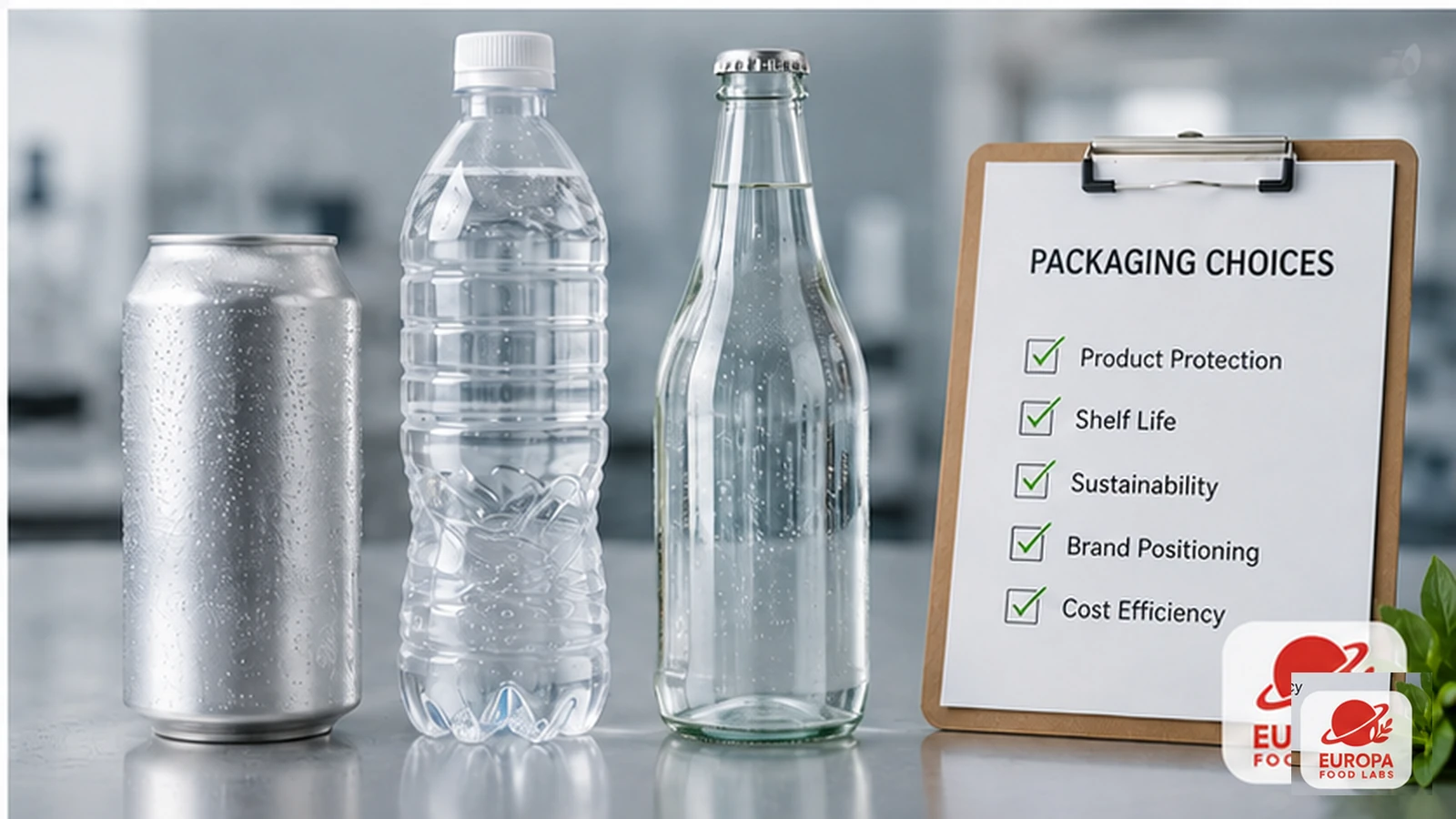
Packaging is not a final decorative choice. It affects the beverage formula, production process, shelf life, logistics, cost, sustainability profile and consumer experience.
Aluminium cans, PET bottles and glass bottles each offer important advantages, but they also introduce different technical and commercial requirements.
The best option depends on the beverage category, target market, expected volume, filling process, distribution route and brand positioning.
Aluminium Cans
Aluminium cans are widely used for energy drinks, functional beverages, carbonated soft drinks, flavoured water, mocktails, beer and ready-to-drink products.
Key advantages include strong protection from light, low weight, efficient palletisation, rapid cooling and a modern premium appearance.
Cans are particularly suitable for carbonated products because they can provide good pressure performance when filled and seamed correctly.
They also offer a large printable surface for branding, whether through direct printing, sleeves or labels.
Technical considerations include seam integrity, internal coating compatibility, carbonation pressure, dissolved oxygen, fill temperature and corrosion risk.
Can production may also involve higher minimum quantities, especially for directly printed designs.
PET Bottles
PET bottles are common for water, juices, iced tea, functional drinks, sports drinks and soft drinks.
Their main advantages are low weight, flexibility in bottle shapes, consumer convenience and comparatively efficient transport.
PET also allows customers to see the beverage, which can be valuable for colourful, natural or premium products.
However, transparency can increase exposure to light, and PET generally offers a different gas and oxygen barrier compared with cans or glass.
This can influence carbonation retention, oxidation, colour stability and flavour performance.
Bottle weight, resin type, barrier technology, cap performance, hot-fill capability and pasteurisation compatibility should all be reviewed.
Glass Bottles
Glass is often associated with premium positioning, hospitality, craft products, juices, mixers, botanical drinks and adult soft drinks.
It offers excellent visual presentation, strong chemical resistance and a high-quality drinking experience.
Glass can provide a very effective barrier to oxygen and carbonation, depending on the closure system.
It is also suitable for products where the package itself is part of the premium brand identity.
The disadvantages are mainly weight, breakage risk, transport cost and handling requirements.
Glass packaging can also require specific filling, cooling, inspection and palletisation procedures.
Formula and Packaging Compatibility
The same beverage may behave differently in different packaging.
Light-sensitive colours or vitamins may be more protected in a can than in a clear bottle.
A highly carbonated drink may require careful PET specification or a pressure-rated glass bottle.
Acidic products, mineral systems, botanical extracts and certain flavour components may also interact differently with closures, liners, coatings or oxygen levels.
Packaging compatibility should therefore be considered during formulation rather than after the recipe is finished.
Shelf-Life Considerations
Shelf life depends on the complete product system.
Important factors include oxygen transmission, light exposure, carbonation loss, closure performance, temperature stability and package integrity.
Cans provide full light protection.
Clear PET and clear glass allow visual inspection but may require protection for light-sensitive products.
PET can be effective for many beverage categories, but the correct bottle and closure specification must match the intended shelf life and distribution conditions.
Production and Filling Requirements
Each package requires suitable equipment.
Cans require rinsing, filling, seaming and seam control.
PET bottles may require bottle blowing, rinsing, filling, capping and label application.
Glass bottles require careful handling, filling, capping and inspection.
Heat treatment can also influence package selection.
Hot fill, tunnel pasteurisation, flash pasteurisation, cold fill and aseptic processing each have different packaging requirements.
The final choice must therefore match the selected production line.
Minimum Order Quantities
Minimum order quantities can strongly influence a new project.
Standard cans, bottles, caps and labels may allow lower entry quantities than custom-shaped or directly printed packaging.
Directly printed cans often require significantly higher volumes than labelled or sleeved cans.
Custom PET bottles and custom glass moulds may involve tooling and larger commitments.
Brands should compare the full commercial setup, not only the unit price.
Brand Positioning
Packaging communicates the product’s market position before the customer tastes it.
Cans often suggest energy, convenience, portability and modernity.
PET may communicate practicality, visibility and everyday usability.
Glass often supports premium, craft, hospitality or traditional positioning.
The best choice should align with retail channel, target consumer, price point and brand story.
Logistics and Export
Weight and pallet efficiency matter, especially for export.
Cans and PET are generally lighter than glass.
Glass can increase freight cost and requires stronger protection against breakage.
Container loading, pallet height, secondary packaging, warehouse handling and local deposit schemes should all be considered.
Sustainability Considerations
Sustainability claims must be evaluated carefully.
Aluminium, PET and glass can all be recyclable, but real-world performance depends on collection systems, recycled content, transport distance, package weight and local infrastructure.
A heavier package may require more transport energy.
A lightweight package may have a different material-recovery profile.
Brands should avoid oversimplified environmental claims and review the full packaging system.
How to Make the Final Decision
A practical packaging decision should consider:
- beverage category
- carbonation level
- sensitivity to oxygen and light
- filling and heat-treatment method
- required shelf life
- production-line availability
- minimum order quantity
- target retail price
- distribution route
- export requirements
- brand positioning
- local recycling and deposit rules
Conclusion
There is no universally best beverage package.
Aluminium cans, PET bottles and glass bottles each perform well when matched correctly with the beverage, process, market and commercial plan.
The right decision comes from reviewing formula, packaging and production together from the beginning of the project.
Europa Food Labs supports packaging-direction review, beverage development and industrial scale-up planning for qualified projects.