

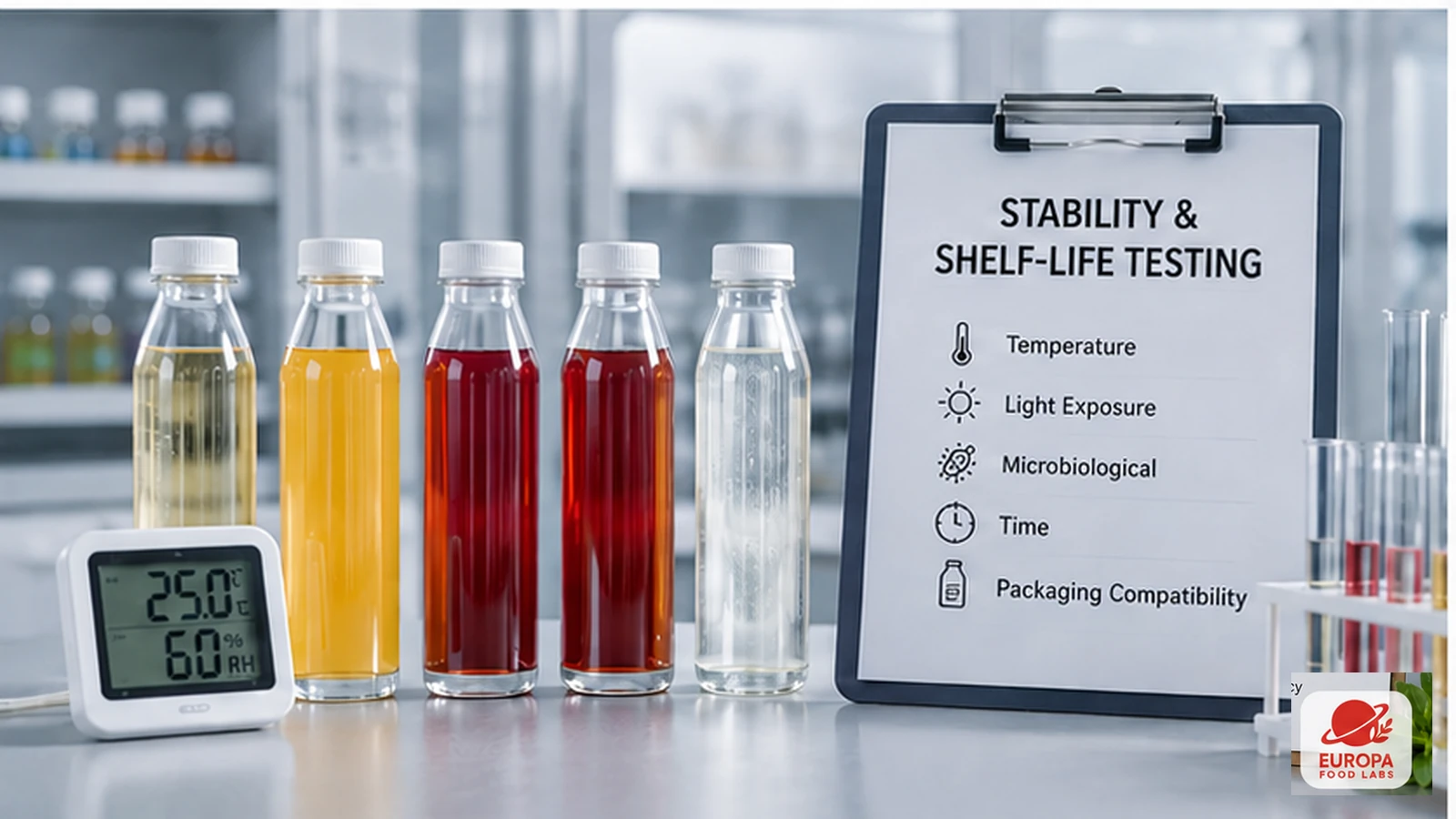
Beverage stability is not a single test or one laboratory result. It is the combined ability of a drink to remain safe, visually acceptable, chemically consistent and sensorially stable throughout its intended shelf life.
A beverage can taste excellent during development and still experience problems later if ingredients, processing, packaging and storage conditions are not considered as one connected system.
Physical Stability
Physical instability can appear as sediment, haze, separation, floating particles, creaming, precipitation or changes in viscosity.
These problems may result from ingredient incompatibility, insufficient hydration, poor dispersion, changes in pH, mineral interactions, temperature exposure or the behaviour of natural extracts and juice components.
A clear beverage may become cloudy over time, while an initially stable emulsion may separate during transport or storage. Physical stability therefore needs to be assessed under realistic conditions rather than only immediately after formulation.
Chemical Stability
Chemical reactions can gradually change flavour, colour, aroma, vitamin content and overall product quality.
Common risks include oxidation, browning, loss of active ingredients, colour degradation, flavour fading and reactions between vitamins, minerals, sweeteners, acids and botanical extracts.
Oxygen exposure, light, heat, metal ions and packaging permeability can all influence the rate of deterioration.
A formula that performs well in glass may behave differently in PET, and a light-sensitive ingredient may require packaging or storage protection.
Sensory Stability
Shelf life is also a sensory question.
The beverage must continue to deliver the intended aroma, flavour, sweetness, acidity, mouthfeel, carbonation and aftertaste.
Some flavour systems become weaker over time. Others change character after heat treatment or storage. Bitterness may increase, citrus notes may fade and botanical profiles may become unbalanced.
Sensory evaluation should therefore be repeated during stability testing rather than performed only on the fresh sample.
Microbiological Safety
Microbiological control is critical.
The formulation, pH, water activity, preservatives, heat treatment, filling conditions, packaging hygiene and storage environment must work together to control microbial risk.
No laboratory recipe alone can guarantee microbiological performance on every production line. Final validation must reflect the selected equipment, process parameters, sanitation procedures and packaging configuration.
Shelf-life claims should be supported by appropriate testing and professional quality review.
Carbonation and Package Performance
Carbonated products introduce additional stability considerations.
CO2 retention depends on temperature, pressure, fill level, closure performance and packaging barrier properties.
Loss of carbonation can change mouthfeel and product perception. Excessive pressure can also create packaging risks.
The can, bottle, cap, seam or closure must therefore be evaluated together with the beverage.
Processing Effects
Mixing order, shear, temperature, holding time, deaeration, pasteurisation, hot filling, cold filling, carbonation and line residence time can all influence final product stability.
A laboratory sample is produced under controlled small-scale conditions. Commercial production introduces larger tanks, pumps, pipes, heat exchangers and filling equipment.
For this reason, scale-up and production trials are essential before final commercial approval.
Storage and Distribution Conditions
The intended shelf life must reflect real storage and distribution conditions.
A product stored in a controlled warehouse may behave differently after exposure to high transport temperatures, repeated temperature changes, light or long export routes.
Brands should define target markets, distribution routes and likely storage conditions early in development.
Testing Strategy
A sensible stability programme may include:
- visual inspection
- pH and acidity checks
- colour monitoring
- aroma and flavour evaluation
- carbonation measurement
- packaging integrity review
- microbiological testing
- accelerated and real-time storage
- comparison across different temperatures and packaging formats
The exact programme depends on the beverage category, ingredients, process, packaging and intended claims.
Responsibility and Final Validation
Development work can reduce risk, but final industrial performance must be validated on the selected production equipment and under the agreed processing conditions.
The beverage developer, ingredient suppliers, manufacturer, quality team and brand owner each have defined responsibilities.
A clear technical transfer process, documented production parameters and formal approval criteria help prevent misunderstandings and reduce commercial risk.
Conclusion
Beverage stability and shelf life should be considered from the beginning of development, not as a final check after the formula is complete.
The most reliable results come from aligning formulation, ingredients, processing, packaging, testing and storage conditions as one complete system.
Europa Food Labs supports structured beverage development, stability-risk review and industrial scale-up planning for qualified projects.